
AI Isn’t Replacing Therapists. It’s Redesigning the Healing Experience.
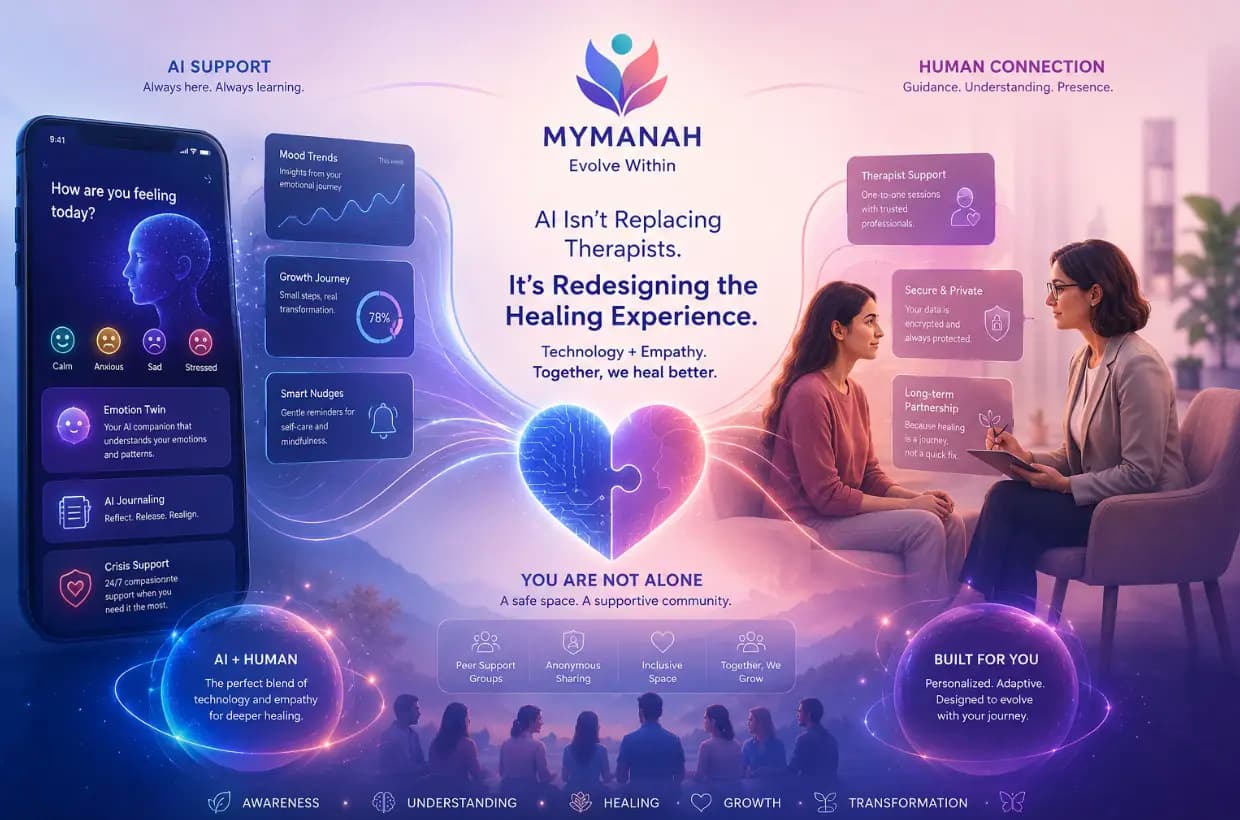
Healing is not being replaced.
It is being reshaped.
There is a fear moving quietly through the modern mind:
If machines can respond, reflect, and even comfort, will therapists become unnecessary?
But healing has never been only about response speed.
It has never been only about information.
It has never been only about intelligence.
Healing is about timing.
Trust.
Containment.
And the kind of presence that makes a person feel less alone inside their own life.
AI does not erase therapy.
It changes the shape of entry.
That distinction matters.
The Conversation Has Already Started
The debate around AI and mental health is no longer theoretical.
People are already using AI-powered tools for emotional support, self-reflection, journaling, and mental wellness check-ins.
The real question is no longer:
- Can AI support mental health?
The real question is:
- How do we use it responsibly?
- Where should human care remain essential?
- How do we build trust, safety, and accountability into these systems?
This is not a story about replacement.
It is a story about redesign.
What AI Can Do That Therapy Alone Cannot
A therapist is human.
That is the strength of therapy.
But humans have limits.
- Sessions end.
- Schedules fill up.
- Clinics close for the day.
- People often struggle most when nobody is available.
A person may be ready to talk at 2:13 AM.
No appointment exists.
No office is open.
AI can help hold that in-between space.
- It can notice repeating emotional patterns.
- It can identify recurring thought loops.
- It can support self-reflection before emotions become overwhelming.
- It can encourage awareness when people might otherwise stay silent.
The future is not:
"AI instead of therapy."
The future is:
"AI before therapy, between therapy, and after therapy."
What Therapy Can Do That AI Must Never Replace
AI can recognize patterns.
It cannot truly witness a human life.
A therapist can:
- Hear what remains unsaid.
- Understand emotional nuance.
- Recognize when silence signals distress.
- Provide ethical responsibility and clinical judgment.
- Offer accountability grounded in human care.
These are not features.
They are deeply human capacities.
And they remain irreplaceable.
AI may help people arrive earlier.
Therapists help people go deeper.
The New Healing Experience Is Layered
The traditional model often worked like this:
Wait until life becomes unbearable.
Then seek help.
The new model is different.
Support can begin before crisis.
AI lowers the friction between suffering and self-awareness.
- Daily emotional check-ins
- Guided reflection
- Mood tracking
- Pattern recognition
- Journaling support
These small moments create continuity.
And continuity often makes therapy more effective when professional care begins.
The future language of mental health is not diagnosis first.
It is awareness first.
Not replacement.
Continuity.
Not one perfect intervention.
A connected system of support.
Why This Matters Now
We are living through a transition period.
The conversation is shifting from:
- "Can AI help?"
To:
- "How do we use AI safely?"
- "How do we protect privacy?"
- "How do we keep humans in the loop?"
The strongest mental health platforms of the future will not be the loudest.
They will be the ones that understand boundaries.
AI should not perform empathy.
It should make empathy easier to reach.
The MyManah View
At MyManah, we do not believe healing should depend on whether someone can reach a session in time.
We believe support should begin earlier.
We believe in AI that listens without pretending to be human.
We believe therapists remain the center of care.
We believe technology should help people understand themselves before crisis takes control.
That is not replacement.
That is redesign.