
The Science of Safe Spaces: Not All Calm Is Healing
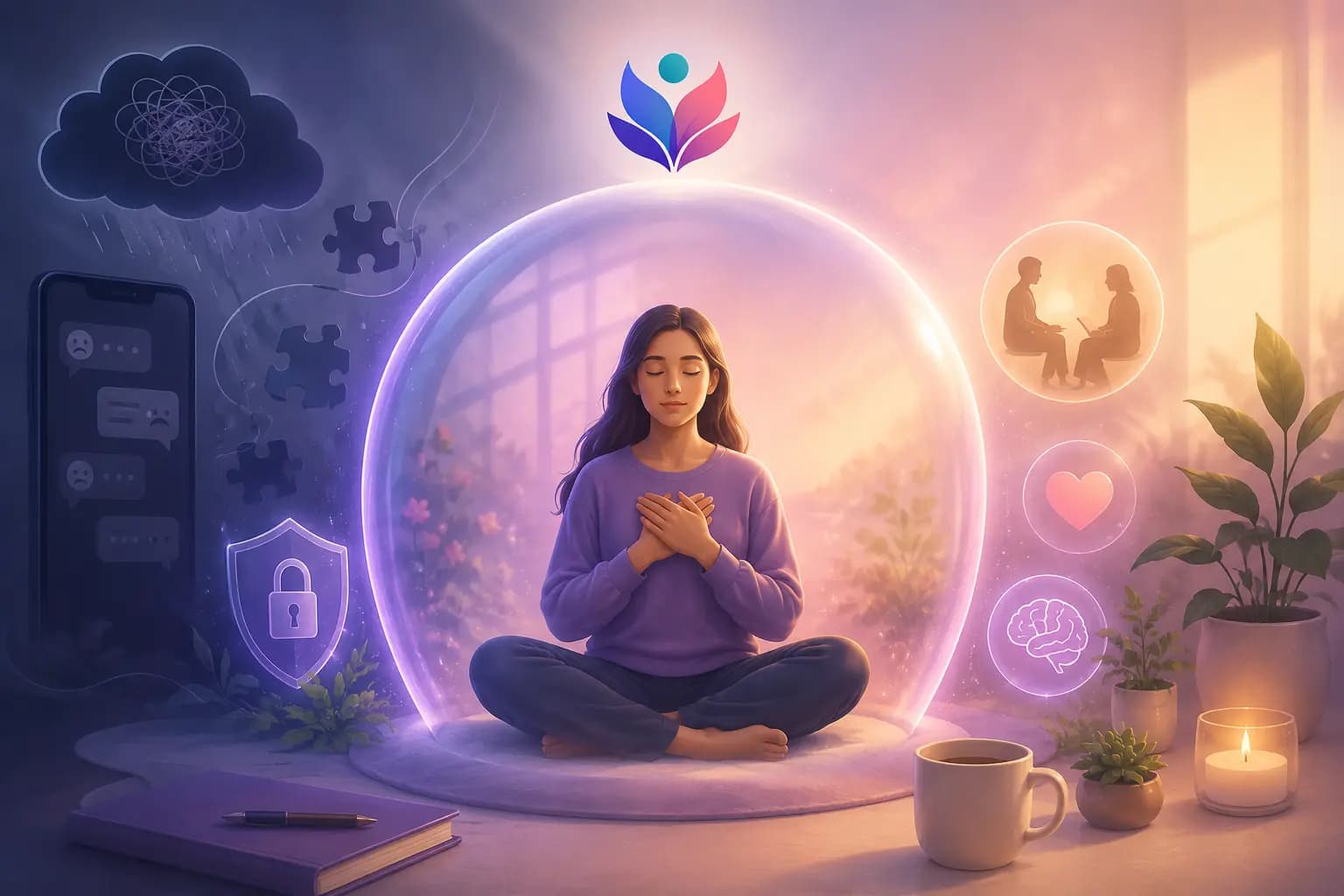
There is a special kind of emptiness that looks peaceful from the outside.
A soft gradient.
A gentle font.
A chatbot that says “I am here for you.”
A few calm animations, a breathing ring, a moonlit screen.
And yet something feels hollow.
Because calm is not the same thing as safety.
A room can be quiet and still feel unsafe.
An app can be beautiful and still leave you more alone than before.
A message can sound compassionate and still have nowhere to take your pain.
That is the problem with much of the wellness language we see today:
It often sells atmosphere before it builds trust.
What a Safe Space Really Is
A true safe space is not defined by softness alone.
It is defined by structure.
- It knows what happens when a person becomes distressed.
- It knows where privacy begins and ends.
- It knows how data is protected.
- It knows when to pause, when to escalate, and when to bring a human into the room.
That is not aesthetic design.
That is clinical design.
This matters now more than ever because the modern mental health user is not just looking for comfort.
They are looking for something that can hold complexity without collapsing into performance.
WHO's 2026 guidance specifically warns that generative AI systems are being used for emotional support despite not being designed or tested for mental health.
The guidance recommends that these tools be co-designed with mental health experts and people with lived experience.
Why Some Wellness Apps Feel Hollow
Many wellness products are built to feel soothing for the first thirty seconds.
Far fewer are built to remain trustworthy after the first difficult disclosure.
That is where the emptiness begins.
NIMH notes that thousands of mental health apps are available and growing, but there is still very little regulation and limited information about their effectiveness.
At the same time, these tools offer meaningful benefits:
- Convenience
- Anonymity
- Lower cost
- Access to support outside clinic hours
So the real question is not whether an app is calm.
The real question is whether it is capable.
- Can it protect user data?
- Can it recognize when a conversation has crossed into crisis?
- Can it avoid manipulating attention for engagement?
- Can it support autonomy instead of dependency?
APA's guidance on mental health apps and generative AI chatbots emphasizes that tools lacking evidence and privacy protections can do more harm than good.
That is the line the market keeps trying to blur:
Soothing interface.
Uncertain safety.
The Science Behind Real Emotional Safety
True emotional safety does not begin with decoration.
It begins with the nervous system's sense that it does not need to defend itself.
People often think healing means feeling calm all the time.
But many people who have experienced emotional stress do not trust calm at first.
Calm can feel suspicious.
Silence can feel like waiting.
A friendly interface can feel like a mask.
That is why design must become more than appearance.
It must become relationship.
Recent research suggests that AI-based mental health tools may improve well-being when they increase emotional self-efficacy and perceived autonomy.
In other words, the tool helps not because it entertains, but because it helps people feel more capable of regulating themselves and more in control of their emotional process.
That is the deeper standard.
A useful mental health tool does not merely say, “Breathe.”
It helps you understand why your body forgot how.
A useful tool does not merely say, “You are safe.”
It shows you what safety looks like in practice:
- Consent
- Privacy
- Accountability
- Escalation pathways
- Human oversight
WHO's recommendations explicitly call for crisis referral frameworks and accountability systems, not just better wording or prettier interfaces.
What to Look for in a Truly Safe Space
If a platform claims to support mental health, it should be able to answer a few plain questions.
- Who sees my data?
- What happens if I mention self-harm or a crisis?
- Is the experience shaped by clinicians, or only by product design?
- Does it create more dependence, or more self-understanding?
- Does it protect dignity when the user is at their most vulnerable?
These are not technical questions.
They are moral ones.
The future of mental health technology will not belong to the loudest calm interface.
It will belong to the systems that make a person feel understood without being exposed, supported without being monitored, and guided without being managed.
The MyManah Principle
A real safe space does not try to look like healing.
It behaves like healing.
- It remembers that users are not metrics.
- It respects that silence can mean safety, or shutdown, or both.
- It leaves room for the human therapist.
- It treats AI as support infrastructure, not emotional authority.
That is why the science of safe spaces is not about making an app feel softer.
It is about making care more honest.
Not all calm is healing.
But when calm is built on evidence, privacy, autonomy, and human responsibility, it can become the beginning of something real.